

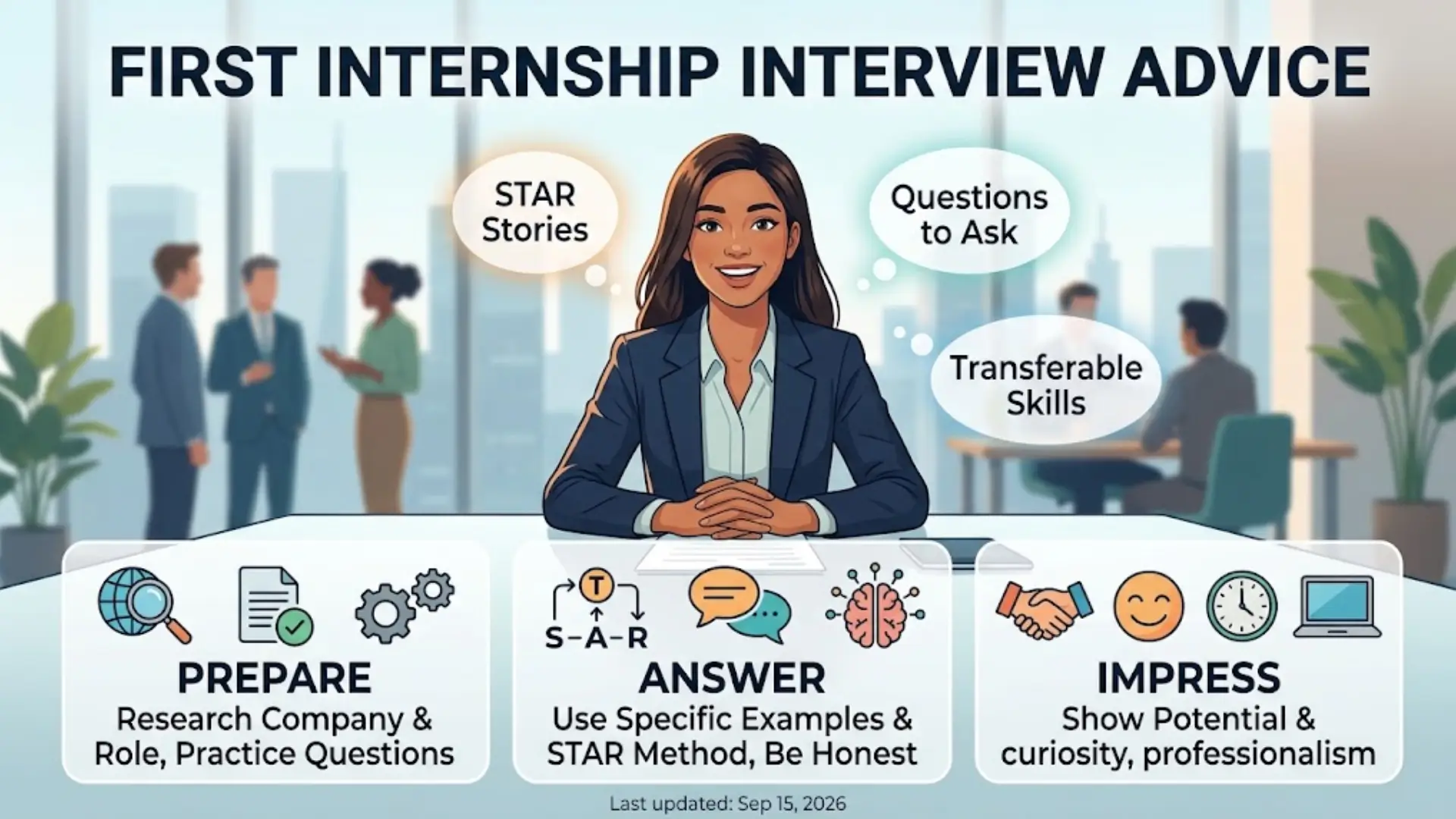
Getting ready for your first internship interview can feel intimidating, especially if you have never been asked professional interview questions before. The good news is that employers generally do not expect interns to have years of industry experience. They want to see potential, communication skills, curiosity, initiative, professionalism, and a genuine willingness to learn.
The best first internship interview advice is to prepare around the specific opportunity rather than trying to memorize perfect answers. Research the organization, understand the internship description, prepare examples from school or other experiences, and practice explaining why you are interested in the role.
Whether your interview is in person, over the phone, or through video, preparation can help you feel more confident and make it easier to show the interviewer what you can contribute.
What Should You Expect in Your First Internship Interview?
A first internship interview may be more conversational than you expect.
The interviewer is usually trying to understand your background, interests, skills, communication style, motivation, and potential fit with the organization. Harvard’s career guidance notes that employers want to understand why you are applying, what you could contribute, and how your transferable skills relate to the position.
You may be asked about:
- Your education or major
- Relevant coursework
- Class projects
- Volunteer work
- Student organizations
- Part-time jobs
- Technical or professional skills
- Career interests
- Strengths and weaknesses
- Why you want the internship
- Why you want to work for the organization
- A time you solved a problem
- A time you worked with a team
- A mistake you made and what you learned
- Your goals for the internship
Do not assume that having little or no professional experience puts you at a disadvantage. Coursework, academic projects, volunteer work, student leadership, and personal projects can all demonstrate useful skills.
How to Prepare for Your First Internship Interview
Good preparation starts before the day of the interview.
Instead of simply searching for generic interview answers, build your preparation around the actual internship.
1. Read the Internship Description Carefully
Go through the job description and identify the skills, responsibilities, qualifications, and characteristics the employer emphasizes.
Look for repeated themes such as:
- Communication
- Research
- Teamwork
- Organization
- Customer service
- Data analysis
- Writing
- Problem-solving
- Leadership
- Creativity
- Technical skills
Then think about where you have demonstrated those abilities.
For example, if the internship asks for teamwork experience, you could discuss a group class project. If it emphasizes organization, you could describe how you managed multiple assignments while meeting deadlines.
The goal is to connect what you have already done with what the employer needs.
2. Research the Organization
You should know more than the company’s name before entering the interview.
Research:
- What the organization does
- Its products or services
- Its target customers
- The industry it operates in
- Recent projects or developments
- The department offering the internship
- The responsibilities listed in the posting
Harvard’s interview guidance recommends understanding the organization and the requirements of the position so you can explain how your skills could contribute.
You do not need to memorize the company’s entire history. Focus on information that helps you explain why the opportunity interests you.
3. Prepare Your Introduction
One of the most common opening questions is:
“Tell me about yourself.”
This question can be surprisingly difficult because it is so broad.
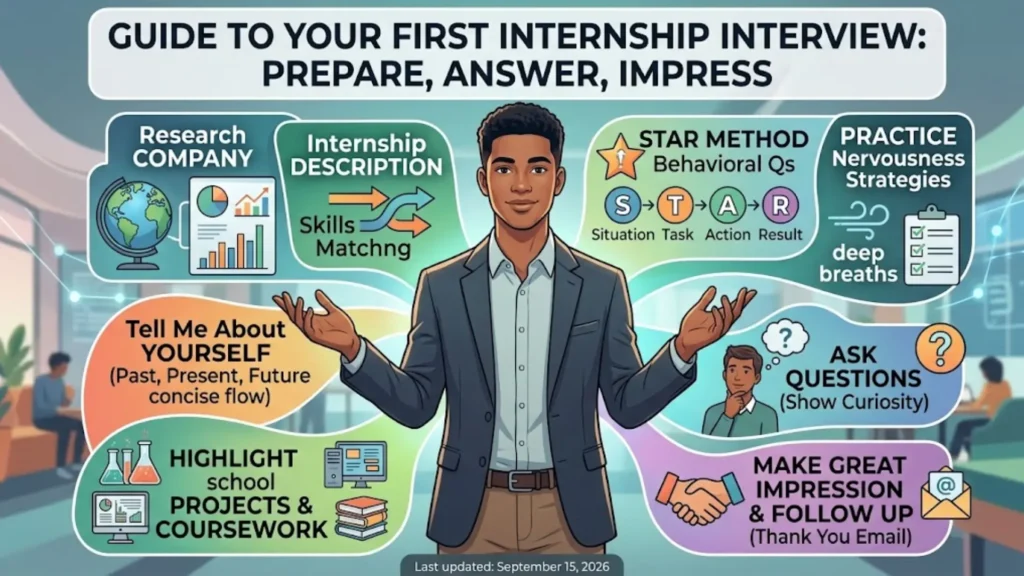
Harvard and Penn career guidance recommend keeping the answer concise and relevant rather than giving a complete biography. A useful structure is past, present, and future.
You might structure your answer like this:
Past: Briefly explain your academic background or relevant experience.
Present: Describe what you are currently studying, working on, or learning.
Future: Explain what you hope to learn or contribute through the internship.
For example:
“I’m currently studying marketing and have become particularly interested in digital content and consumer behavior. Through several class projects, I’ve developed experience researching audiences and presenting campaign ideas. I’m now looking for an internship where I can apply those skills in a professional environment while learning more about how marketing teams develop and measure campaigns.”
Keep your answer focused. You want to start a conversation, not deliver your entire resume.
How to Answer Internship Interview Questions
Your answers do not need to sound perfect.
They need to be clear, specific, honest, and connected to the position.
Use Examples Instead of General Claims
Compare these two responses:
Weak:
“I’m a hard worker and a good team player.”
Stronger:
“During a group research project last semester, our team was struggling to divide the workload. I created a shared task list, assigned responsibilities based on everyone’s strengths, and set earlier internal deadlines. We finished the project on time and received one of the highest grades in the class.”
The second answer provides evidence instead of simply making a claim.
Harvard recommends using specific examples and explaining your individual role, what you did, and what you learned.
Use the STAR Method for Behavioral Questions
Behavioral questions often begin with phrases such as:
- “Tell me about a time…”
- “Describe a situation…”
- “Give me an example…”
- “What would you do if…”
The STAR method can help organize your response:
S = Situation
Explain the context.
T = Task
Describe what needed to be accomplished.
A = Action
Explain what you personally did.
R = Result
Describe the outcome and what you learned.
Career-services guidance commonly recommends this structure for behavioral interview questions.
For an internship candidate, your examples do not have to come from another internship. You can use school projects, volunteer activities, clubs, sports, part-time jobs, or personal projects when they demonstrate relevant skills.
Common First Internship Interview Questions
Preparing for likely questions can reduce anxiety and help you organize your thoughts.
“Tell Me About Yourself”
Give a short professional introduction that connects your background to the internship.
Avoid discussing unrelated personal information or repeating every line of your resume.
“Why Do You Want This Internship?”
Explain what interests you about the work and what you hope to learn.
A strong answer connects the internship with your academic interests or career direction.
“Why Do You Want to Work Here?”
Show that you researched the organization.
Mention something specific about its work, products, mission, industry, or current projects that genuinely interests you.
“What Are Your Strengths?”
Choose one or two strengths that are relevant to the internship and support them with examples.
Instead of saying:
“I’m very organized.”
Try:
“I’m organized, particularly when I have several deadlines at once. Last semester, I used a weekly planning system to manage three major projects while keeping up with regular coursework.”
“What Is Your Biggest Weakness?”
Choose something genuine but manageable.
The important part is explaining what you are doing to improve it.
For example:
“I used to spend too much time trying to make every assignment perfect. I’ve been working on prioritizing tasks and setting time limits so I can maintain quality without losing efficiency.”
Avoid turning the answer into a disguised compliment such as “My weakness is that I work too hard.”
“Why Should We Choose You?”
Focus on the combination of skills, interest, reliability, and willingness to learn that you bring.
You do not need to convince the interviewer that you are already an expert. An internship is a learning opportunity.
“Where Do You See Yourself in a Few Years?”
You can discuss the skills or professional direction you hope to develop.
You do not need to have your entire career mapped out.
What If You Have No Work Experience?
This is one of the biggest concerns for first-time internship applicants.
The answer is simple: professional experience is not the only type of experience.
Harvard’s current internship guidance specifically notes that students can demonstrate relevant abilities through coursework, academic projects, student leadership, volunteer work, and independent projects.
Consider examples from:
- Class presentations
- Research assignments
- Group projects
- Student organizations
- Volunteer work
- Freelance projects
- Personal websites
- Coding projects
- Design portfolios
- Campus jobs
- Retail or hospitality work
- Sports teams
- Community activities
The key is to explain what you did and what skill it demonstrates.
A class project can show research and teamwork. A personal website can demonstrate initiative. A part-time job can demonstrate communication and responsibility.
How to Talk About Your Coursework
Your coursework can become useful interview material when you connect it to the internship.
Instead of saying:
“I took a marketing class.”
Explain:
“In my marketing course, I worked on a semester-long campaign project where I researched a target audience, developed a content strategy, and presented our recommendations to the class.”
This gives the interviewer evidence of practical skills.
Think about three or four courses that relate most closely to the position and prepare short examples from each.
How to Show You Are Willing to Learn
Internships are designed to provide professional learning experiences, so employers do not expect you to know everything.
Instead of pretending to know something you do not, demonstrate curiosity.
You can say:
“I haven’t had the opportunity to work with that software yet, but I’ve used similar tools and I’m comfortable learning new systems.”
This communicates honesty, adaptability, and confidence.
Current career guidance also emphasizes initiative, curiosity, professionalism, communication, and willingness to learn as qualities that can help students stand out even without extensive experience.
How to Handle Nervousness During Your First Interview
Feeling nervous is normal.
You do not need to eliminate nervousness completely. Instead, prepare enough that you can function comfortably despite it.
Try these strategies:
Practice Out Loud
Reading answers silently is not the same as speaking them.
Practice answering questions aloud so you can hear whether your responses are too long, unclear, or repetitive.
Record a Practice Interview
Use your phone or computer to record yourself answering several questions.
Look for:
- Speaking too quickly
- Excessive filler words
- Looking away constantly
- Very long answers
- Monotone delivery
- Unclear explanations
Pause Before Answering
You do not have to respond instantly.
A brief pause gives you time to understand the question and organize your thoughts.
Do Not Memorize Every Word
Memorized answers can sound unnatural.
Prepare key points and examples instead.
Penn Career Services specifically notes that practice should help candidates communicate clearly and confidently rather than simply memorize answers.
How to Make a Good First Impression
Your first impression begins before you answer the first question.
Arrive Early
For an in-person interview, plan your route in advance and arrive with enough time to settle down.
For a virtual interview, test your technology beforehand and enter the meeting early.
Dress Appropriately
Your clothing should fit the organization’s professional environment.
When uncertain, choose a clean, polished and professional appearance.
Make Eye Contact
For in-person interviews, maintain comfortable eye contact.
For video interviews, look toward the camera when speaking rather than constantly watching your own image.
Speak Clearly
Do not rush because you are nervous.
Speak at a comfortable pace and make your answers easy to follow.
Show Interest
Your tone and body language should communicate that you genuinely want the opportunity.
Interviewers are evaluating more than technical qualifications. Communication, professionalism, interest and fit can all influence their impression.
What Questions Should You Ask the Interviewer?
When the interviewer asks, “Do you have any questions for me?”, avoid saying you have none.
Prepare several questions in advance.
Good examples include:
- What would a typical day look like for an intern in this role?
- What projects would an intern likely work on during the first few weeks?
- How do you measure success for interns?
- What skills would you most like the person in this role to develop?
- How does the team typically support interns during the learning process?
- What do you enjoy most about working here?
- What are the next steps in the interview process?
Thoughtful questions demonstrate that you are interested in understanding the role rather than simply getting an offer. Career-services resources specifically encourage candidates to prepare questions for the interviewer.
Questions You Should Avoid Asking Too Early
Some questions can create the wrong impression if they are your only focus during an initial interview.
For example, avoid making the conversation primarily about:
- Time off
- Leaving early
- How little work you can do
- Benefits before understanding the role
- Information already explained in the job posting
Compensation and schedule can be important, but the timing and context matter.
First demonstrate that you understand and are interested in the opportunity.
First Internship Interview Advice for Video Interviews
Virtual interviews require many of the same preparation steps as in-person interviews, but there are additional technical considerations.
Before the interview:
- Test your camera.
- Test your microphone.
- Check your internet connection.
- Charge your device.
- Choose a quiet location.
- Remove distracting background items.
- Close unnecessary browser tabs and applications.
- Keep your resume and job description nearby.
- Put your phone on silent.
- Confirm the interview platform.
Harvard’s interviewing guidance recommends planning the location for phone or video interviews so you have privacy, a quiet environment and reliable reception.
What Should You Bring to an In-Person Internship Interview?
Depending on the interview format, consider bringing:
- Several copies of your resume
- A portfolio, if relevant
- A notebook
- A pen
- A list of questions
- Any requested documents
- A copy of the internship description
Even if the interviewer already has your resume, having a copy available can help you reference specific projects or experiences.
What Should You Do After the Interview?
Your preparation does not end when you leave the interview.
Send a short thank-you email after the conversation.
Penn Career Services recommends sending a thank-you message within roughly 12 to 24 hours and making it specific to the conversation.
A good message should:
- Thank the interviewer for their time
- Mention something specific from the conversation
- Reinforce your interest in the opportunity
- Keep the message concise
- Use the interviewer’s name correctly
Do not send a generic paragraph that could have been sent to every company.
Common First Internship Interview Mistakes
Even strong candidates can hurt their chances through avoidable mistakes.
1. Not Researching the Company
If you cannot explain what the organization does, your interest may appear weak.
2. Memorizing Answers
Prepared answers are useful, but overly rehearsed responses can sound unnatural.
3. Giving One-Word Answers
Interviewers need enough information to understand your skills and experience.
4. Talking Too Much
Long answers can bury your strongest points.
Answer the question, provide the relevant example, and stop.
5. Saying You Have No Questions
Prepare questions before the interview.
6. Pretending to Know Everything
For an internship, honesty and willingness to learn are more valuable than pretending to have expertise.
7. Speaking Negatively About Others
Avoid criticizing professors, previous employers, classmates or other candidates.
8. Forgetting to Follow Up
A concise thank-you message can reinforce professionalism and interest.
A Simple First Internship Interview Checklist
Use this checklist the day before your interview:
- Read the internship description again.
- Research the organization.
- Identify three to five skills the employer wants.
- Prepare examples demonstrating those skills.
- Practice “Tell me about yourself.”
- Prepare answers to common questions.
- Prepare two or three STAR stories.
- Prepare questions for the interviewer.
- Choose appropriate clothing.
- Confirm the interview time and location.
- Test your technology if the interview is virtual.
- Prepare your resume and portfolio.
- Plan to arrive early.
- Prepare a short thank-you message for afterward.
What Makes a First-Time Internship Candidate Stand Out?
You do not necessarily need the longest resume or the most impressive list of qualifications.
A strong first-time candidate can stand out by demonstrating:
Preparation: You understand the organization and role.
Curiosity: You ask thoughtful questions.
Communication: You explain your ideas clearly.
Initiative: You can demonstrate things you have done without being required to have professional experience.
Self-awareness: You understand your strengths and areas for improvement.
Adaptability: You are willing to learn.
Professionalism: You are reliable, respectful and prepared.
These qualities matter because internships are learning opportunities. Employers need students who can absorb information, contribute to a team and develop professionally.
Frequently Asked Questions
What should I say in my first internship interview?
Focus on your education, relevant skills, projects, interests and reasons for wanting the internship. Use specific examples rather than simply listing qualities.
What if I have no previous internship experience?
That is completely normal for a first internship. Use coursework, class projects, volunteer work, student organizations, personal projects and part-time employment to demonstrate transferable skills.
How should I answer “Tell me about yourself” in an internship interview?
Use a concise structure covering your background, what you are doing now and what you hope to learn or accomplish in the internship. Harvard recommends keeping this response focused and generally within about one to two minutes.
What questions are commonly asked in a first internship interview?
Common questions include “Tell me about yourself,” “Why do you want this internship?”, “Why do you want to work here?”, “What are your strengths and weaknesses?”, and behavioral questions asking for examples of teamwork, problem-solving or handling challenges.
Should I use the STAR method for an internship interview?
Yes. STAR can help you organize behavioral answers into Situation, Task, Action and Result. Your examples can come from school, volunteer activities, student organizations or other experiences, not just professional jobs.
What should I wear to my first internship interview?
Choose clean, polished clothing that fits the organization’s professional environment. When uncertain, it is generally safer to be slightly more professional than too casual.
Should I send a thank-you email after an internship interview?
Yes. A short, personalized thank-you message can reinforce your professionalism and interest. Penn Career Services recommends sending one within approximately 12 to 24 hours.
What should I ask at the end of an internship interview?
Ask questions about the role, projects, expectations, team, learning opportunities and next steps. Avoid asking questions that are already clearly answered in the job description.
Final Thoughts
The best first internship interview advice is to stop worrying about sounding like an experienced professional and focus on demonstrating your potential.
You are not expected to know everything. Instead, show that you prepared, understand the opportunity, can communicate clearly, have relevant skills or experiences, and are genuinely interested in learning.
Research the organization, prepare several specific examples, practice common questions, use the STAR structure when appropriate, and prepare thoughtful questions of your own. Most importantly, let your answers sound like you rather than a memorized script.
A first internship interview is not just a test. It is an opportunity to show an employer what you can contribute now and how much you are ready to learn next.