

Pakistan Monsoon Flood Warning
Pakistan is bracing for another intense round of monsoon rain, and this time the warning covers nearly the entire country. The Pakistan Meteorological Department has issued a clear alert, and the numbers behind the previous spell show why this one deserves attention.
Here is exactly what’s coming, which cities face the highest flooding risk, and what steps actually help you stay safe during this period.
What the PMD Has Announced
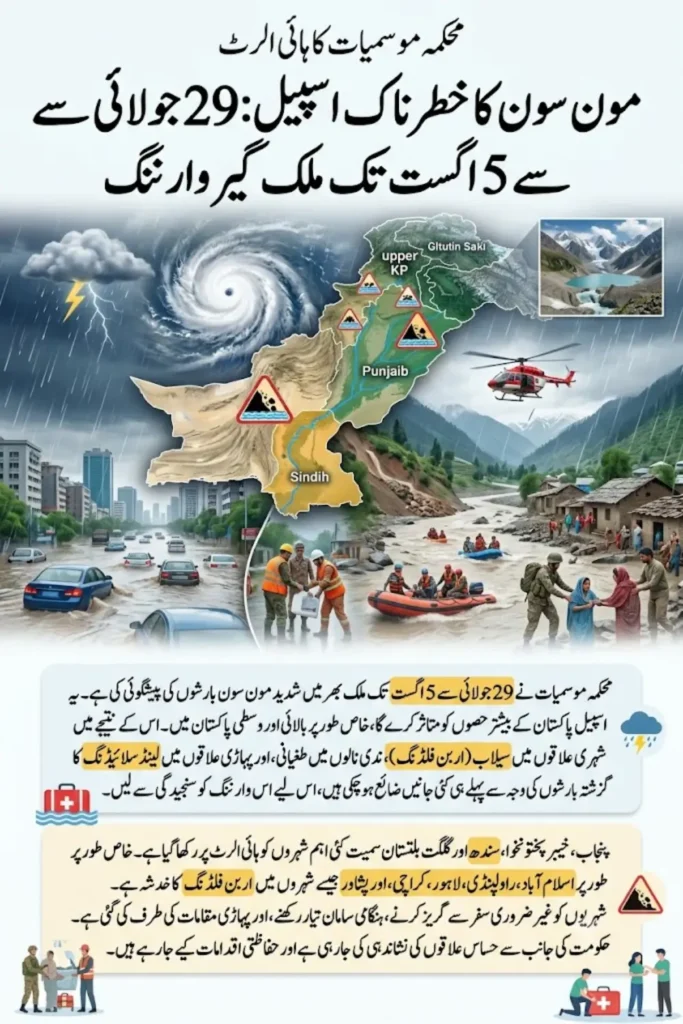
The Pakistan Meteorological Department issued a nationwide weather advisory warning that a fresh monsoon spell will affect the country from July 29 to August 5. The department says moisture-laden currents from the Arabian Sea and the Bay of Bengal will move into the upper and central parts of Pakistan starting July 29.
A separate westerly weather system currently active in the north is expected to strengthen from August 1, which means the rainfall is likely to intensify rather than ease as the week goes on. The PMD has directly warned that this combination could trigger urban flooding, flash floods, and landslides across large parts of the country.
Which Areas Are Most at Risk
The advisory doesn’t treat the whole country the same way. Different regions face different types of risk depending on terrain and timing.
Punjab and Islamabad
Islamabad, Rawalpindi, Murree, Galliyat, Attock, Chakwal, Jhelum, Mandi Bahauddin, Gujrat, Gujranwala, Hafizabad, Wazirabad, and Sialkot are expected to see rain and thunderstorms with scattered heavy falls from July 29 to August 4.
Urban flooding specifically threatens low-lying parts of Islamabad, Rawalpindi, Peshawar, Nowshera, Gujranwala, Gujrat, Sialkot, Lahore, Multan, and Faisalabad between July 30 and August 4.
Southern Punjab districts, including Bahawalpur, Bahawalnagar, Rahim Yar Khan, Khanpur, Multan, Vehari, Khanewal, Lodhran, Muzaffargarh, Kot Addu, Dera Ghazi Khan, and Rajanpur, are expected to see scattered heavy rainfall from July 31 to August 3.
Khyber Pakhtunkhwa
Most KP districts, including Dir, Chitral, Swat, Kohistan, Malakand, Nowshera, Charsadda, Karak, Tank, Lakki Marwat, Swabi, Peshawar, Mardan, and several others, are expected to receive widespread rain with occasional very heavy falls between July 29 and August 5.
Sindh
Urban flooding is expected specifically in Nawabshah, Sukkur, Shaheed Benazirabad, Hyderabad, Thatta, Badin, Sanghar, Khairpur, Mithi, Mirpurkhas, Umerkot, Tando Muhammad Khan, and Tando Allahyar between July 31 and August 2. Karachi is also expected to receive rain during this period.
Gilgit-Baltistan and Northern Areas
GB is likely to see moderate to heavy rainfall starting from Tuesday evening. Landslides are a specific concern in vulnerable parts of upper KP, GB, Murree, Galliyat, and Kashmir between July 30 and August 5, given the hilly terrain and already-saturated ground from earlier rains.
Also Read: Apna Ghar Mehfooz Ghar Scheme 2026 – Rs 1 Million
The Damage From the Previous Spell
This new warning comes while Pakistan is still recovering from the last monsoon spell, which gives a sense of how serious the situation already is. According to figures shared during a government briefing, 110 people have lost their lives in rain-related incidents during the ongoing monsoon season, with 360 people injured.
The same briefing reported that 796 houses have been damaged and 376 livestock animals have died so far. These figures matter because they show this isn’t an isolated warning about a single storm, but part of a monsoon season that has already caused significant loss.
Why This Spell Could Be More Dangerous Than Usual
Officials have also flagged a longer-term risk tied to this monsoon season. Rising global temperatures have accelerated glacier melting in Pakistan’s northern regions, which increases the risk of Glacial Lake Outburst Floods, commonly known as GLOFs, along with flash floods over the coming weeks.
This means the danger isn’t limited to rainfall alone. In northern areas, melting glaciers combined with heavy rain can raise river levels faster than usual, catching downstream communities off guard even when local rainfall seems moderate.
Safety Precautions During This Monsoon Spell
The PMD and disaster management authorities have issued specific guidance for this period, and following it can make a real difference.
For residents in flood-prone or low-lying areas:
- Avoid unnecessary travel during the forecast period, especially between July 30 and August 4 when urban flooding risk peaks.
- Keep emergency supplies ready, including drinking water, a charged power bank, and essential medicines.
- Avoid driving through flooded roads, since water depth is often impossible to judge from inside a vehicle.
- Move valuables and important documents to higher parts of your home if you live in a known flood-prone area.
For farmers and livestock owners:
- Plan agricultural activities around the forecast rather than against it, since heavy rain during this window could damage standing crops.
- Ensure livestock have access to elevated, dry shelter, particularly in areas already flagged for urban or flash flooding.
For travelers and tourists:
- Avoid trips to Murree, Galliyat, and other hill station areas during this period, since landslide risk is specifically elevated there.
- Check road conditions before heading toward northern areas, as heavy rain can trigger sudden closures.
General precautions that apply nationwide:
- Strong winds and lightning may damage solar panels, electricity poles, and billboards, so stay clear of these structures during storms.
- Keep mobile phones charged in case of power outages, which are common during heavy spells.
- Follow updates directly from PMD and local disaster management authorities rather than relying on unverified social media posts.
Also Read: Apna Ghar Mehfooz Ghar Scheme 2026 – Rs 1 Million
What Authorities Are Doing
The government has confirmed that vulnerable areas have already been identified and precautionary measures are being implemented. Immediate steps have also been taken to control urban flooding risk in central Punjab, including Lahore, ahead of this fresh spell.
Provincial disaster management authorities in Punjab and Sindh have issued their own province-specific advisories aligned with the PMD’s nationwide warning, directing local administrations to remain on alert throughout this period.
Also Read: Punjab Ration Card Programme Gets Rs43.2 Billion Boost
Conclusion
Pakistan faces a genuinely serious weather event between July 29 and August 5, with urban flooding, flash floods, and landslides possible across Punjab, KP, Sindh, and the northern areas. Given that the ongoing monsoon season has already caused over a hundred deaths and significant property damage, taking the PMD’s precautions seriously this week is not optional caution, it’s necessary preparation.
Also Read: Petrol Price Today in Pakistan – 28 July 2026 Update
Frequently Asked Questions
1. When will the next monsoon spell hit Pakistan?
The PMD has forecast widespread rain from July 29 to August 5, 2026, with the heaviest rainfall expected between July 30 and August 4 in many areas.
2. Which cities face the highest urban flooding risk?
Islamabad, Rawalpindi, Peshawar, Nowshera, Gujranwala, Gujrat, Sialkot, Lahore, Multan, and Faisalabad face urban flooding risk between July 30 and August 4, while Sindh cities including Sukkur, Hyderabad, and Mirpurkhas face similar risk from July 31 to August 2.
3. Is landslide risk part of this warning?
Yes, landslides are specifically flagged for vulnerable areas in upper KP, Gilgit-Baltistan, Murree, Galliyat, and Kashmir between July 30 and August 5.
4. How many people have died in this year’s monsoon season so far?
As of this latest advisory, 110 people have died and 360 have been injured in rain-related incidents during the ongoing monsoon season.
5. Why is there also a flood risk from glaciers this year?
Accelerated glacier melting in Pakistan’s northern regions has increased the risk of Glacial Lake Outburst Floods and flash floods alongside the rainfall itself.
6. What should I do to stay safe during this spell?
Avoid unnecessary travel, especially to hill stations, keep emergency supplies ready, avoid driving through flooded roads, and follow updates directly from PMD and local disaster management authorities
Also Read: Why Gold Price Jumped Rs4,000 Today Pakistan Rate Explained