


Pakistan New Oil Refining Policy
Pakistan just approved one of its most significant energy sector reforms in years, and it could change how much you pay at the pump for years to come. The government has signed off on a new oil refining policy aimed at unlocking billions of dollars in investment.
Here’s what this policy actually changes, why the government pushed for it now, and what it means for fuel quality and prices going forward.
What the Government Just Approved
Prime Minister Shehbaz Sharif approved key amendments to Pakistan’s Oil Refining Policy 2023 while chairing a meeting of the Cabinet Committee on Energy. The revised framework is designed to unlock billions of dollars in investment, cut fuel imports, and pave the way for cleaner Euro-5 fuel production in Pakistan.
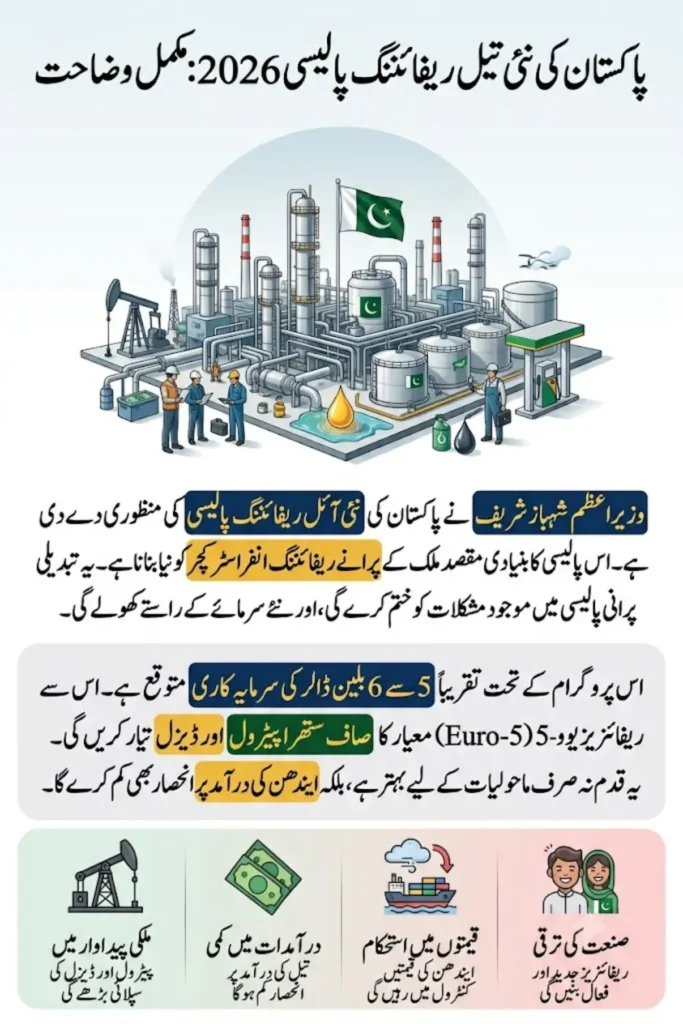
This isn’t a brand-new policy built from scratch. It amends and strengthens the existing Brownfield Refining Policy that was first introduced in 2023, addressing problems that had slowed down investment under the original framework.
Also Read: Punjab Ration Card Programme Gets Rs43.2 Billion Boost
Why This Policy Was Necessary
Pakistan’s refining sector has been running on ageing infrastructure for years, and the original 2023 policy struggled to attract the investment it promised. Refiners had raised concerns that changes introduced through the Finance Act 2024, which shifted petroleum products from a zero-rated to an exempt sales tax regime, made planned refinery upgrades financially unviable.
The Petroleum Division acknowledged that these tax changes hurt the economics of refinery modernisation projects, which is part of why this revised policy went through months of negotiation between the government and the refining industry before reaching approval.
Also Read: Pakistan Monsoon Flood Warning – July 29 to August 5
How Much Investment Is Expected
The government estimates this refinery modernisation programme could attract between $5 billion and $6 billion in investment across Pakistan’s five major refineries: PARCO, Attock Refinery Limited, National Refinery Limited, Pakistan Refinery Limited, and Cnergyico.
To put that scale in perspective, this covers essentially the entire domestic refining industry, not just one or two companies. If even a large share of this investment materialises, it would represent the biggest modernisation push Pakistan’s refining sector has seen in decades.
Also Read: CM Punjab Rehmat Card 2026: JazzCash Digital Payments Now Started
What Changes for Fuel Production
The core purpose of this policy is upgrading old refineries so they can produce better fuel in larger quantities. The expected improvements are substantial:
| Metric | Expected Change |
|---|---|
| Petrol production | Nearly doubles |
| Diesel production | Increases by around 47% |
| Furnace oil production | Cut by roughly 78% |
| Annual foreign exchange savings | $1 billion to $3 billion |
Furnace oil has become increasingly uneconomical to produce anyway, since domestic demand for it has been falling. Cutting its output while boosting petrol and diesel production lets refineries focus on what the market actually needs.
Also Read: Apna Ghar Mehfooz Ghar Scheme 2026 – Rs 1 Million Interest-Free Loan Guide
Moving to Euro-5 Fuel Standards
One of the policy’s headline goals is enabling refineries to produce Euro-5 and Euro-4 compliant petrol and diesel for the first time on a wide scale. Cleaner fuel standards mean lower harmful emissions from vehicles, which matters for both air quality and Pakistan’s international environmental commitments.
Refinery-specific upgrade plans include:
- PARCO, currently producing Euro-3 fuel, plans to shift entirely to Euro-5 specifications, with motor gasoline output rising from around 3,678 tonnes per day to roughly 4,023 tonnes per day.
- Attock Refinery Limited, which already produces Euro-5 gasoline, will upgrade its diesel production to Euro-5 standards as well.
- Pakistan Refinery Limited plans to produce Euro-5 diesel alongside its existing Euro-5 gasoline output.
- National Refinery Limited is planning one of the most significant overhauls of its product mix under this programme.
Incentives Offered to Refineries
To make these expensive upgrades worthwhile for refinery operators, the policy includes a seven-year package of fiscal incentives. Key protections and benefits include:
- Seven years of tariff protection through a deemed duty mechanism.
- Legal safeguards against adverse future changes to taxation, environmental regulation, or foreign exchange rules.
- Permission for refineries to open onshore foreign currency accounts to service their external debt obligations.
- Stability and parity clauses specifically designed to reassure foreign investors and international lenders financing these projects.
In exchange for these incentives, refineries must sign legally binding Upgrade Agreements with OGRA within 90 days of the policy’s notification. Existing operators must also give up their previous incentive package to qualify for the new one, meaning this is a genuine trade-in rather than an additional bonus stacked on top of old benefits.
Accountability and Compliance Measures
Given how much public benefit is riding on these projects actually getting completed, the policy also builds in oversight mechanisms rather than relying purely on trust.
- Independent technical verification of upgrade progress.
- Biannual audits carried out by leading audit firms.
- Refineries with outstanding government liabilities remain ineligible for incentives until those issues are resolved.
- Refineries must maintain strategic crude oil reserves equal to 14 days of supply, with an additional 5-day reserve required for refineries relying on imported crude.
Notably, the policy recommends against punitive action for refineries that fail to complete upgrades within the prescribed timeframe, favoring project continuation and renegotiation over penalties that could derail investment altogether.
What This Means for Ordinary Consumers
For everyday fuel users, this policy’s impact will show up gradually rather than overnight. Petroleum Minister Ali Pervaiz Malik has indicated the government intends to move toward market-based fuel pricing while maintaining regulatory oversight, alongside publishing daily international benchmark prices to reduce arbitrage between refiners and OGRA.
Over the coming years, successful implementation could mean less dependence on imported refined fuel, cleaner emissions from vehicles running on Euro-5 fuel, and reduced pressure on foreign exchange reserves, since less crude and refined product would need to be imported.
Also Read: Why Gold Price Jumped Rs4,000 Today Pakistan Rate Explained
Conclusion
Pakistan’s revised oil refining policy is a genuine attempt to fix a modernisation programme that had stalled since 2023, offering refineries seven years of incentives in exchange for nearly $6 billion in upgrades that boost petrol and diesel output while cutting furnace oil production. Whether this translates into real savings and cleaner fuel for ordinary Pakistanis will depend on how quickly refineries sign their Upgrade Agreements and follow through on these commitments.
Also Read: Petrol Price Today in Pakistan – 28 July 2026 Update
Frequently Asked Questions
1. What is Pakistan new oil refining policy?
It’s a revised version of the 2023 Brownfield Refining Policy, offering refineries fiscal incentives to modernise and produce cleaner Euro-5 compliant fuel.
2. How much investment is this policy expected to attract?
The government estimates between $5 billion and $6 billion in investment across Pakistan’s five major refineries.
3. Which refineries are covered under this policy?
PARCO, Attock Refinery Limited, National Refinery Limited, Pakistan Refinery Limited, and Cnergyico are the five major refineries involved.
4. Will this policy affect petrol and diesel prices?
The government has signaled a gradual move toward market-based pricing with continued oversight, alongside daily international benchmark publication, though pump price impact will unfold over time as upgrades are completed.
5. What is Euro-5 fuel and why does it matter?
Euro-5 is a cleaner fuel standard that produces significantly lower harmful vehicle emissions compared to older fuel grades, helping Pakistan meet international environmental commitments.
6. What happens if a refinery fails to complete its upgrade on time?
The policy recommends against punitive action for missed timeframes, focusing instead on project continuation rather than penalties.
Also Read: Punjab Ration Card Programme Gets Rs43.2 Billion Boost