

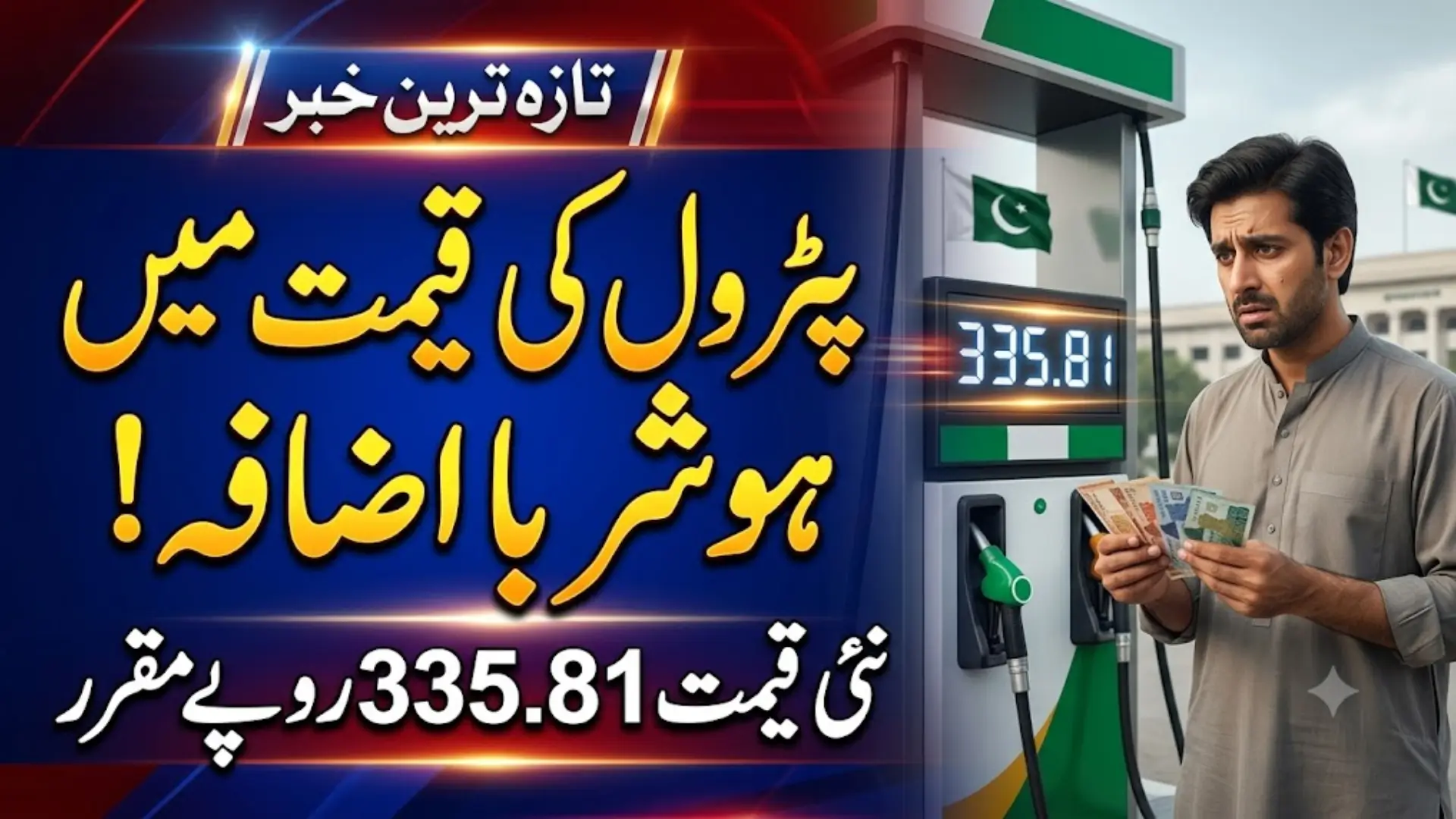
Petrol Price Today in Pakistan
Fuel prices in Pakistan have gone up again, and this time the increase comes with a twist that has left many people confused. International oil prices actually fell sharply on the same day, yet local pump prices still climbed.
Here’s the new rate, the real reason behind this unusual gap, and what the last two weeks of pricing tell us about where things are headed.
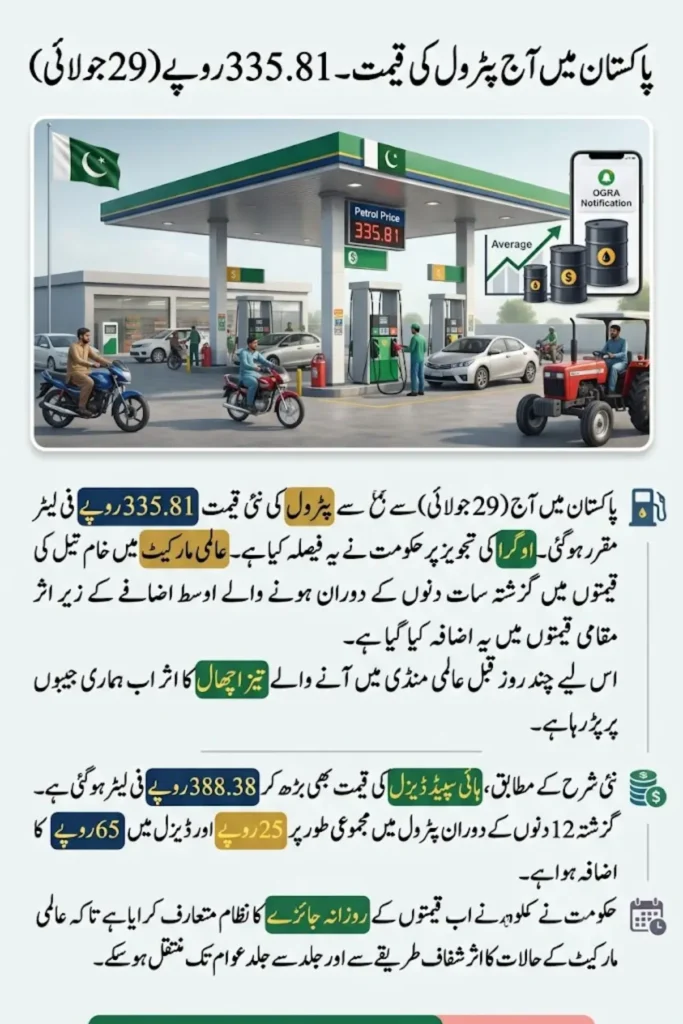
Petrol and Diesel Price in Pakistan Today (29 July 2026)
The Ministry of Energy’s Petroleum Division, acting on OGRA’s recommendation, issued fresh ex-depot rates effective from midnight.
| Fuel Type | Previous Rate | New Rate | Change |
|---|---|---|---|
| Petrol | Rs 334.18 | Rs 335.81 | Up Rs 1.63 |
| High-Speed Diesel (HSD) | Rs 386.83 | Rs 388.38 | Up Rs 1.55 |
These revised rates apply uniformly across Punjab, Sindh, Khyber Pakhtunkhwa, and Balochistan.
Why Prices Rose Even Though Global Oil Fell
This is the part that confuses most people, so it’s worth explaining clearly. On the very day Pakistan raised its fuel prices, international crude oil actually dropped around 5 percent to a two-week low, as traders grew cautiously hopeful about a resolution to the ongoing Iran conflict.
So why did Pakistan’s price go up instead of down? The answer lies in timing. Pakistan’s daily pricing formula is based on a seven-day rolling average of international rates, not the price from a single day. That means today’s local rate still reflects the sharp spike in global oil prices from the days just before this drop, when tensions were at their peak.
Also Read: Apna Ghar Mehfooz Ghar Scheme 2026 – Rs 1 Million
The Spike That’s Still Feeding Into Local Prices
Just days earlier, Brent crude had jumped 6 percent to touch 100.50 US dollars a barrel, its highest level since late May. This spike followed attacks on tankers in the Red Sea, which disrupted a major Middle East shipping route, combined with Iran’s near-closure of the Strait of Hormuz, one of the world’s most critical oil transit points.
Because Pakistan’s formula averages the past week of international prices rather than reacting to a single day, that earlier spike is still working its way through the local pricing system even as global prices begin to cool off. This lag is a normal feature of rolling-average pricing, but it does mean local consumers sometimes feel price increases a few days after the actual global spike, and price relief a few days after prices ease internationally too.
How Much Fuel Prices Have Risen Recently
Looking at the bigger picture makes today’s increase easier to understand. Over the past 12 days alone, petrol prices have risen by a cumulative Rs 25 per litre, while high-speed diesel has climbed by Rs 65 per litre.
Zooming out further, petrol has increased by more than Rs 21 per litre since 27 June 2026, despite two small dips along the way, on 4 July and 21 July. This steady upward trend, interrupted only briefly, reflects just how volatile the global oil market has been this summer.
Understanding Pakistan’s New Daily Pricing System
Pakistan shifted away from its old weekly petroleum price review system after Petroleum Minister Ali Pervaiz Malik announced on 17 July 2026 that OGRA would begin updating prices daily. The goal was to let domestic prices react more quickly to international market swings, rather than leaving consumers locked into an outdated rate for two weeks at a time.
Key features of the current pricing mechanism:
- OGRA calculates and publishes new ex-depot prices daily without needing separate government approval for each announcement.
- Prices are based on the imported cost of fuel combined with a seven-day average of international benchmark rates.
- The petroleum levy stays within limits set by the cabinet, and any change to it requires separate approval from the Finance Ministry.
- International reference prices are published on OGRA’s website daily, a transparency measure that has been mandatory since 1 July 2026.
This system was introduced specifically because renewed tensions between Washington and Tehran created unpredictable swings in global energy markets, and the old two-week review cycle left Pakistan’s prices badly out of step with what was actually happening internationally.
What This Means for Different Fuel Users
Petrol and diesel serve different parts of the economy, so a price change affects people differently depending on what they drive or run.
- Private motorists and commuters feel the petrol increase most directly, since it raises the daily cost of driving to work or school.
- Public transport operators often pass rising fuel costs on to passengers through higher fares over time.
- Farmers and industrial users are more affected by diesel price changes, since HSD powers tractors, generators, and heavy machinery.
- Freight and logistics businesses watch diesel closely too, since transport costs directly shape the price of goods reaching the market.
Also Read: Why Gold Price Jumped Rs4,000 Today Pakistan Rate Explained
What to Watch For Next
Since Pakistan’s pricing formula tracks a seven-day average, the direction of the next revision will depend heavily on whether international crude prices continue falling from their recent spike. If global oil prices ease and the rupee holds steady against the dollar, the next few revisions could bring smaller increases or even a slight decrease, similar to the dips seen earlier this month.
On the other hand, if tensions in the Middle East escalate again, expect the local price to keep climbing, even with a short delay built into the averaging system.
Also Read: Punjab Ration Card Programme Gets Rs43.2 Billion Boost
Conclusion
Petrol in Pakistan now costs Rs 335.81 per litre and diesel Rs 388.38 per litre as of 29 July 2026, driven by a earlier spike in Brent crude tied to Middle East tensions, even as international prices eased on the day of this announcement. With daily pricing now in place and the seven-day averaging effect still working through the system, checking the latest OGRA notification remains the most reliable way to plan any major fuel purchase.
Also Read: Pakistan Monsoon Flood Warning – July 29 to August 5
Frequently Asked Questions
1. What is the petrol price in Pakistan today?
Petrol is priced at Rs 335.81 per litre as of 29 July 2026, up Rs 1.63 from the previous rate.
2. What is the diesel price in Pakistan today?
High-speed diesel is priced at Rs 388.38 per litre, up Rs 1.55 from the previous rate.
3. Why did fuel prices rise when international oil prices fell?
Pakistan’s pricing formula uses a seven-day average of international rates, so today’s price still reflects an earlier spike in Brent crude, even though prices eased on the day of the announcement.
4. Why did Brent crude spike recently?
Attacks on tankers in the Red Sea and Iran’s near-closure of the Strait of Hormuz pushed Brent crude to 100.50 US dollars a barrel, its highest level since late May.
5. How much have fuel prices risen this month?
Petrol has risen by more than Rs 21 per litre since 27 June 2026, and by a cumulative Rs 25 per litre over just the past 12 days.
6. Why did Pakistan switch to daily fuel pricing?
The government introduced daily price reviews from 17 July 2026 to keep local rates aligned with volatile international oil markets caused by renewed US-Iran tensions.
Also Read: Punjab Ration Card Programme Gets Rs43.2 Billion Boost